Skip to content

The Traveler

Enter The Traveler

The Traveler exists outside of a fixed time.

He moves through songs, places, memories, and moments — witnessing familiar human questions surface in different forms.

He is not bound to one landscape, one era, or one aesthetic.

A song may lead him into the desert. Another may carry him toward the coast. Another may belong somewhere that has not yet been imagined.

The Traveler is the evolving visual world surrounding Chuck Wooke’s music — a continuing journey in which songs become Chapters and each Chapter creates a world of its own.

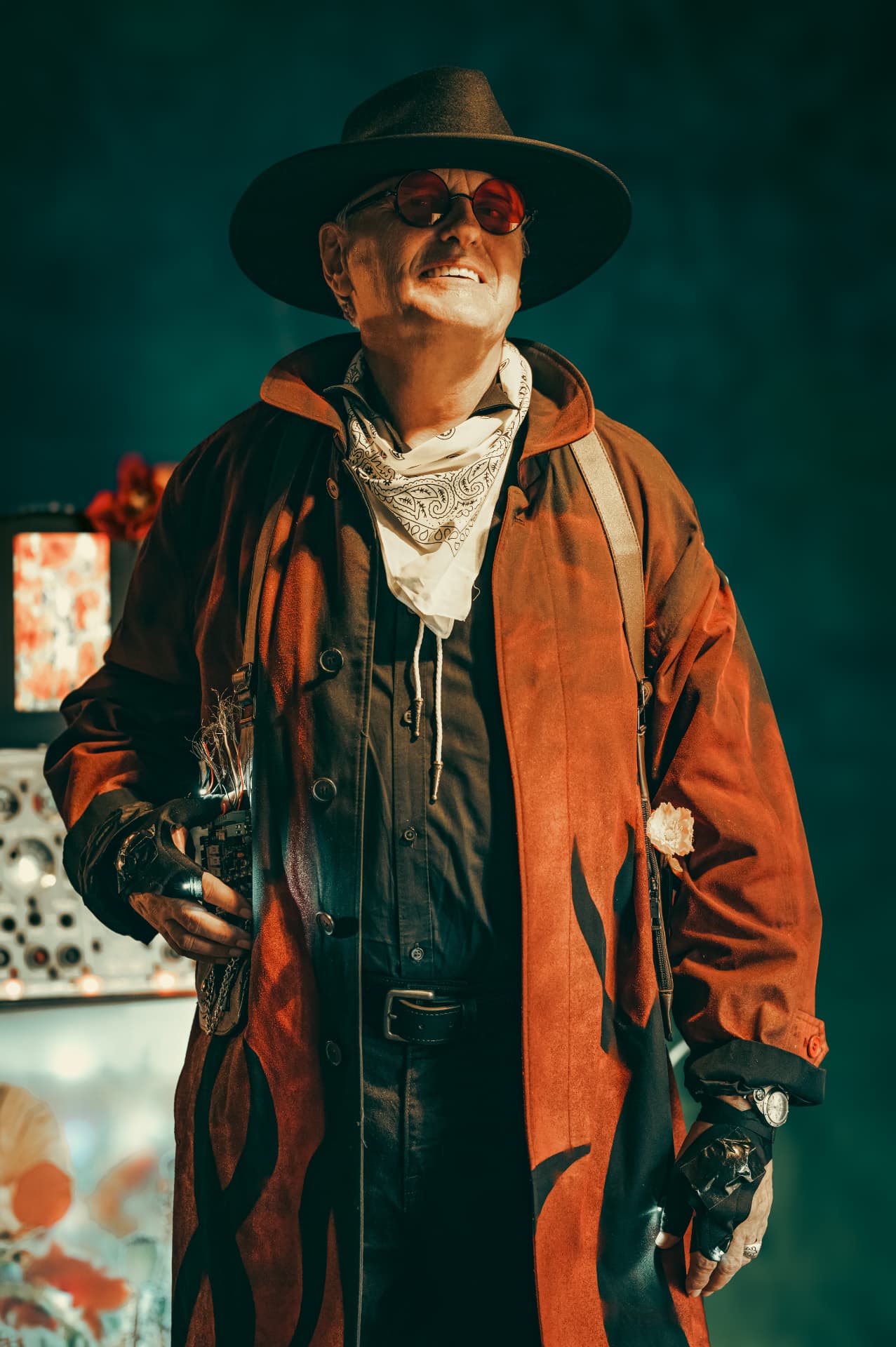
Chuck Wooke as The Traveler in a wide-brimmed hat, red round glasses, bandana and flame-painted rust coat, holding a wired circuit device before a dark teal backdrop

The Story

A Character Without a Fixed Time

The Traveler is part narrator, part witness, part collector.

He moves through changing places and moments without completely belonging to any one of them.

Rather than being defined by a literal journey through history, The Traveler moves through the emotional spaces created by Chuck Wooke’s music — memory, distance, longing, connection, discovery, loss, hope, and the choices people continue to face regardless of when or where they live.

He collects traces of those places along the way.

Not necessarily treasures in the traditional sense, but objects that seem to have absorbed a story — a worn photograph, a watch, an instrument, rusted metal, leather, an old mechanism, dust from a road, or something whose original purpose may have been forgotten.

These artifacts become fragments of memory.

Some belong to one Chapter.

Others may return later.

The objects do not need to be explained literally. Their meaning can emerge through repetition, photography, video, and the music surrounding them.

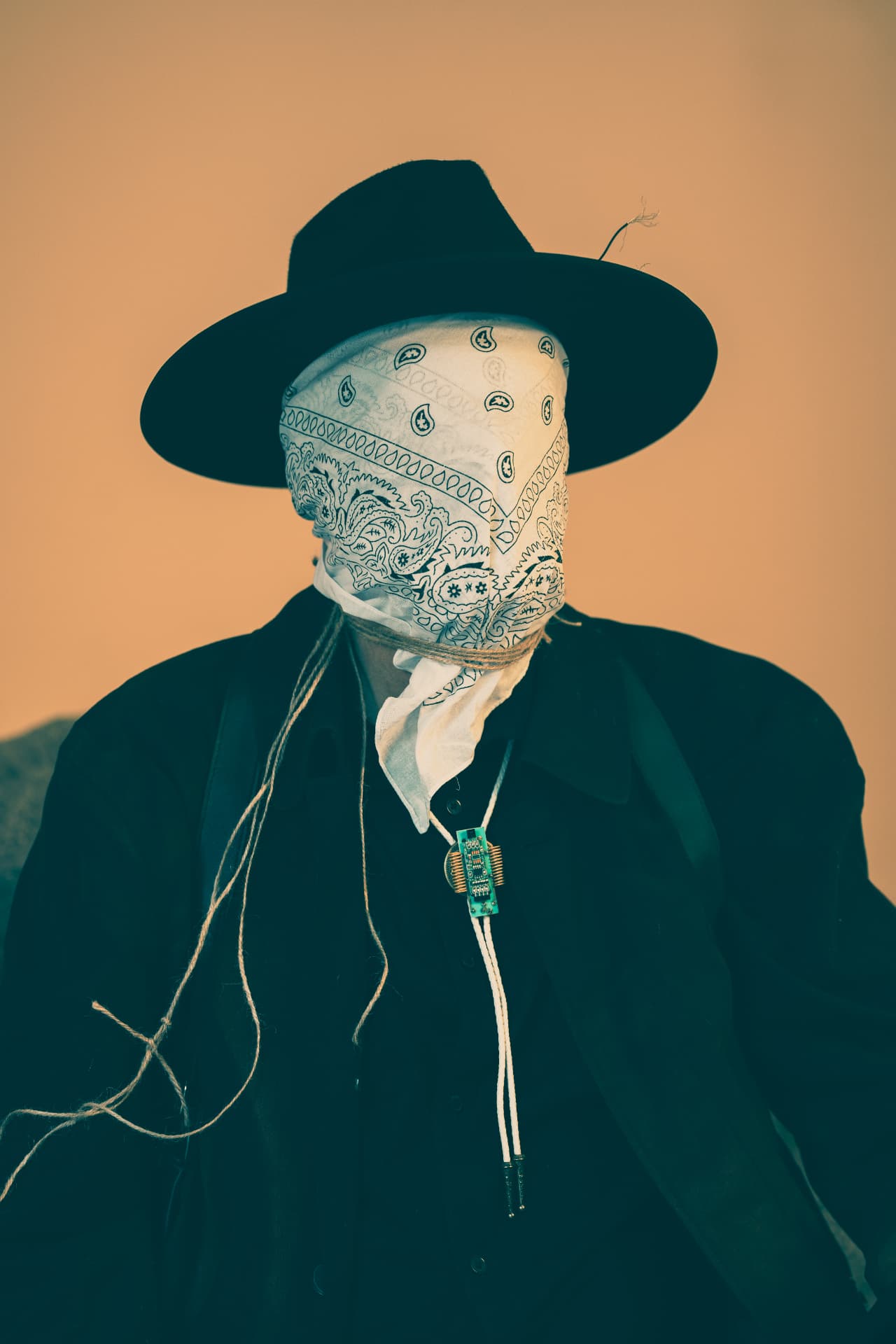
Chuck Wooke as The Traveler, his face wrapped in a white paisley bandana tied with twine, wearing a black hat and a circuit-board bolo tie

The first visual spark for the character came from Chuck’s idea of a “techno cowboy” — a version of himself moving between different eras while the world around him changed.

Western clothing, mechanical gadgets, shifting film textures, and steampunk influences provided the earliest ingredients.

Chuck also shared inspiration from strange sculptural lighting and mechanical artwork that transformed old industrial objects into something unfamiliar and difficult to place in time.

Katie Cooper began developing those influences into a different visual direction: analog punk.

Analog punk uses real, tactile materials — obsolete technology, wires, switches, mechanical parts, worn surfaces, repurposed equipment, handmade devices, and objects that feel as though they belonged to another purpose before becoming part of The Traveler’s world.

Rather than imagining a polished future, analog punk makes the future feel assembled from the past.

At the same time, Katie began weaving Chuck’s music together with his memories, decades of stories, places he had traveled, instruments, objects, emotion, and history as a musician.

The literal time traveler became The Traveler.

The cowboy became one influence rather than the entire identity.

Steampunk became one starting point rather than the finished aesthetic.

The machinery became part of a larger language of memory, artifacts, movement, and things collected along the way.

The character evolved into what Chuck responded to as a “time traveller collector” — someone who can move through songs, places, memories, and visual worlds without belonging completely to any single era.

The landscape changes.

The clothes change.

The objects change.

The music changes.

The human questions remain.

This allows The Traveler to exist wherever Chuck Wooke’s music leads next.

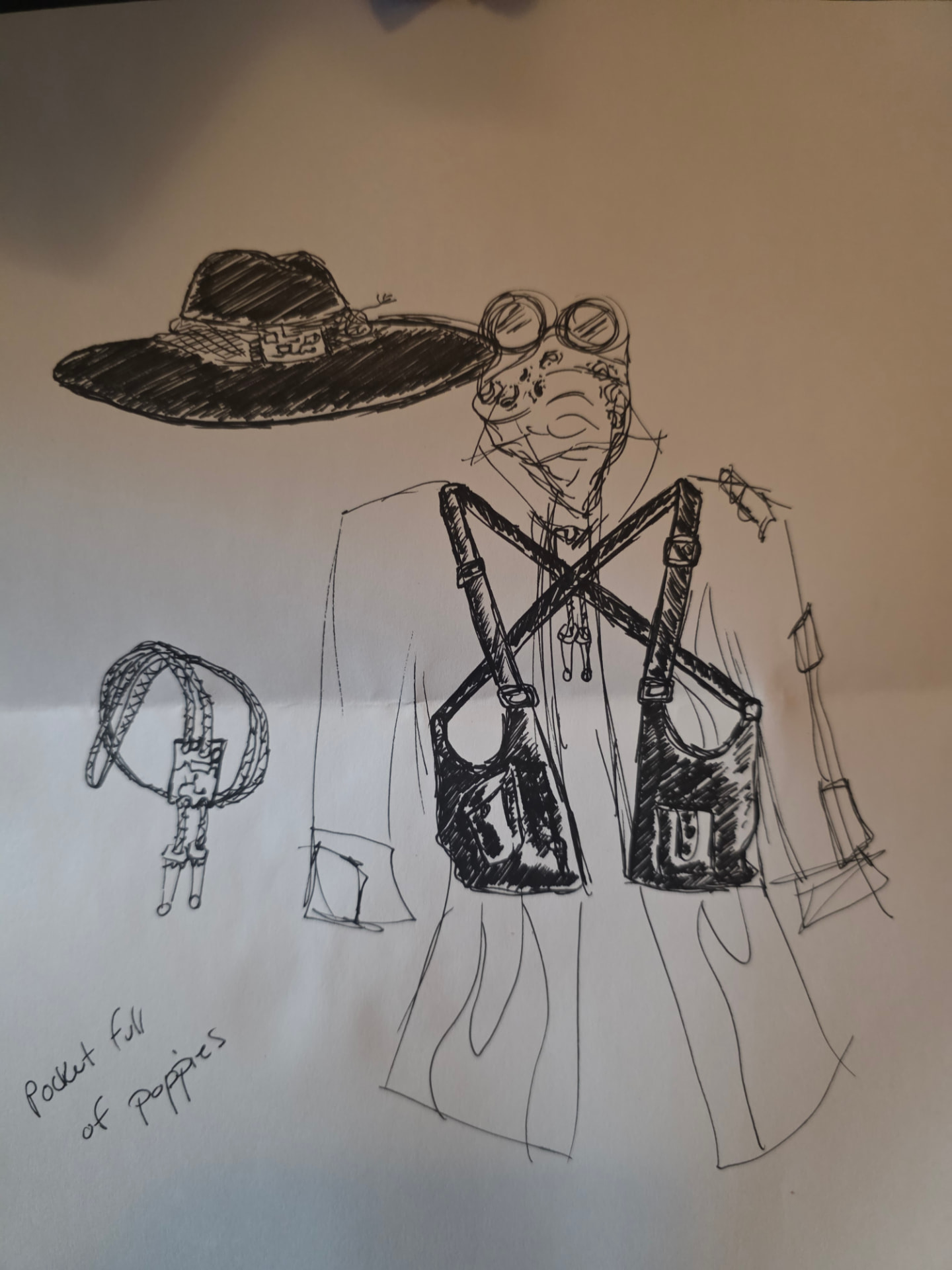
Early pen sketch of The Traveler: wide-brimmed hat, goggles, long coat with crossed leather satchel straps, a bolo tie, and the handwritten note "Pocket full of poppies"
“The Traveler exists outside of time.”

Creative Development

Built with Katie Cooper Photography

The Traveler grew from two very different kinds of creative material.

Chuck Wooke brought the music — along with the raw emotion, personal history, places he has traveled, decades of experience as a musician, and a lifetime of stories gathered along the way.

Katie Cooper Photography brought the visual world.

Before the sets, wardrobe, props, photography, or video existed, Katie began piecing together Chuck’s ideas, memories, music, and visual references and weaving them into a larger story.

Those pieces became the foundation for The Traveler: a character, a visual language, and a Chapter-based world capable of evolving alongside Chuck’s music.

Katie developed that world through story development, creative direction, character design, analog-punk visual development, set construction, wardrobe and prop development, photography, video direction, location planning, visual branding, and the creation of the environments surrounding each Chapter.

The process has remained intentionally experimental.

Hand-painted backgrounds, vintage televisions, a broken arcade cabinet, modified clothing, instruments, cables, found mechanical objects, technical equipment, macro photography, portraits, interviews, and location work have all become pieces of the same evolving world.

Chuck brings the songs, the history, and the stories.

Katie gives those stories a visual place to exist.
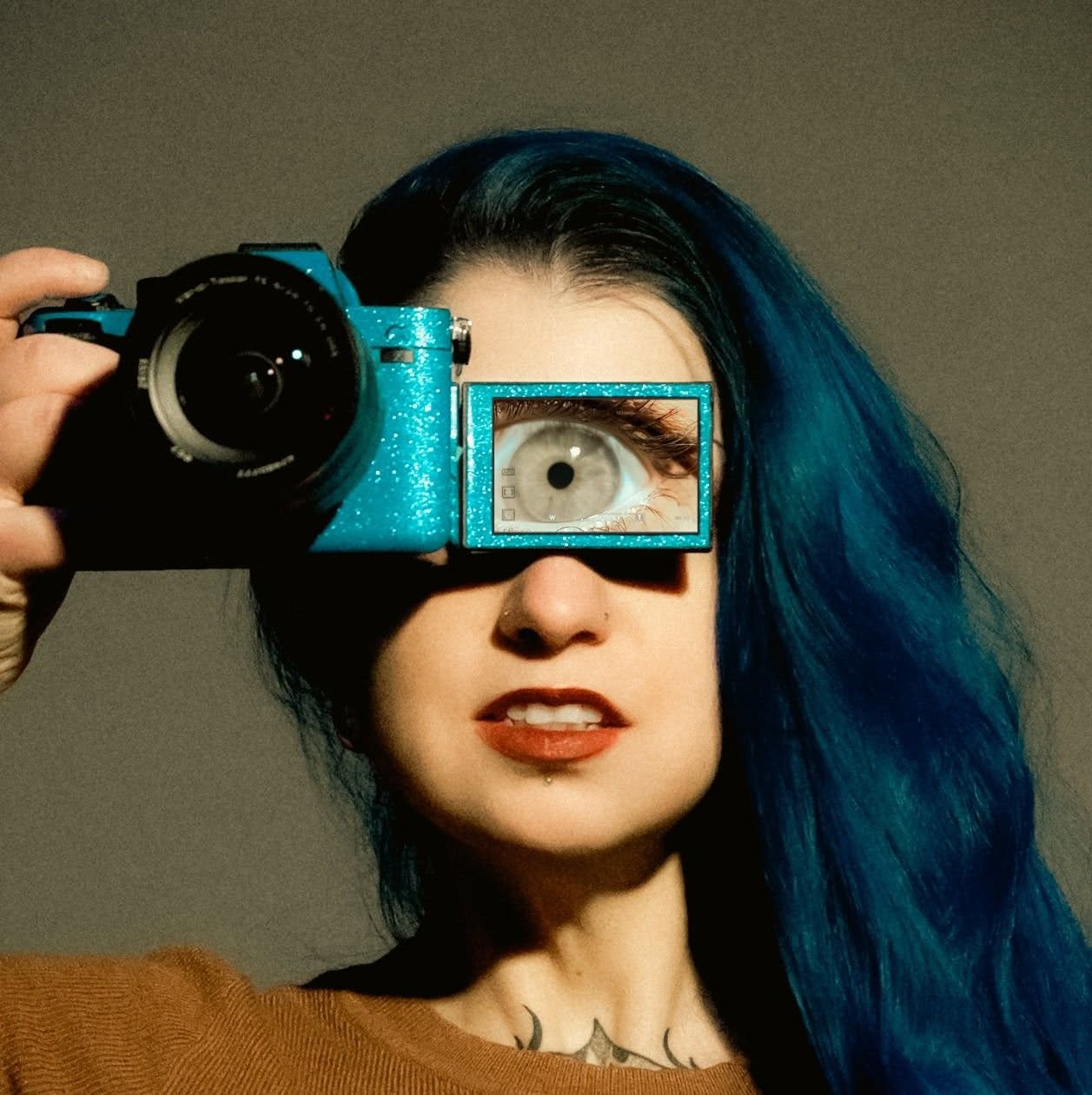
Katie Cooper with long blue hair holding a glitter-teal camera to her face, its flip screen showing her eye

Katie Cooper Photography

Creative Direction · Visual Storytelling · Photography · Video

Katie Cooper Photography is a Tucson-based creative photography and visual-art practice focused on cinematic portraiture, conceptual world-building, and image-driven storytelling.

For The Traveler, Katie Cooper serves as the project’s visual architect — taking the music, memories, history, places, emotion, and ideas Chuck brings into the process and shaping them into a cohesive visual narrative.

Her role includes story development, creative direction, character development, set design and construction, wardrobe and prop development, photography, video production, location work, visual branding, and the continuing development of each Traveler Chapter.

From Song to World

  1. 01

    The Song

    Chuck’s music, emotion, memories, and lived experience create the starting point.

  2. 02

    The Story

    Katie pulls together the ideas, places, objects, memories, and themes surrounding the music and shapes them into a visual narrative.

  3. 03

    The World

    Location, color, texture, wardrobe, architecture, objects, atmosphere, and character are developed around that story.

  4. 04

    The Build

    Sets, backgrounds, props, wardrobe pieces, found objects, locations, photography, and video are created, sourced, tested, and refined.

  5. 05

    The Chapter

    The finished work becomes another visual world within The Traveler.

Behind the Scenes

Making The Traveler

The finished images are only part of the story.

Making The Traveler documents how Chuck’s music, memories, and lived experiences are translated into visual storytelling through concept development, set building, wardrobe, props, photography, video, location work, and experimentation.

Ideas are built, tested, photographed, changed, sometimes discarded, and often transformed into something completely different once the creative process begins.

This evolving archive shows the work behind the world.

How the World Is Seen

Journey
Wide environmental imagery places The Traveler inside a larger world — landscape, roads, architecture, weather, scale, and distance.
Person
Closer portraits return the focus to Chuck — expression, performance, posture, and stillness keep the story connected to the musician at its center.
Memory
Details carry quieter stories — hands, instruments, photographs, watches, worn surfaces, machinery, clothing, and collected objects.
Distortion
Occasionally reality bends — movement, unusual perspective, reflections, texture, editing, or visual transitions can suggest a change in memory, place, or Chapter.

The Chapters

Every Song Can Open Another Door

The Traveler changes with the music.

A Chapter is more than another costume, location, or photoshoot. Each Chapter can become its own world — shaped by the song and the story surrounding it.

A new Chapter may introduce a different landscape, wardrobe, collection of objects, color palette, photography style, or approach to video.

The Traveler does not force every song into the same aesthetic.

The world changes to meet the music.

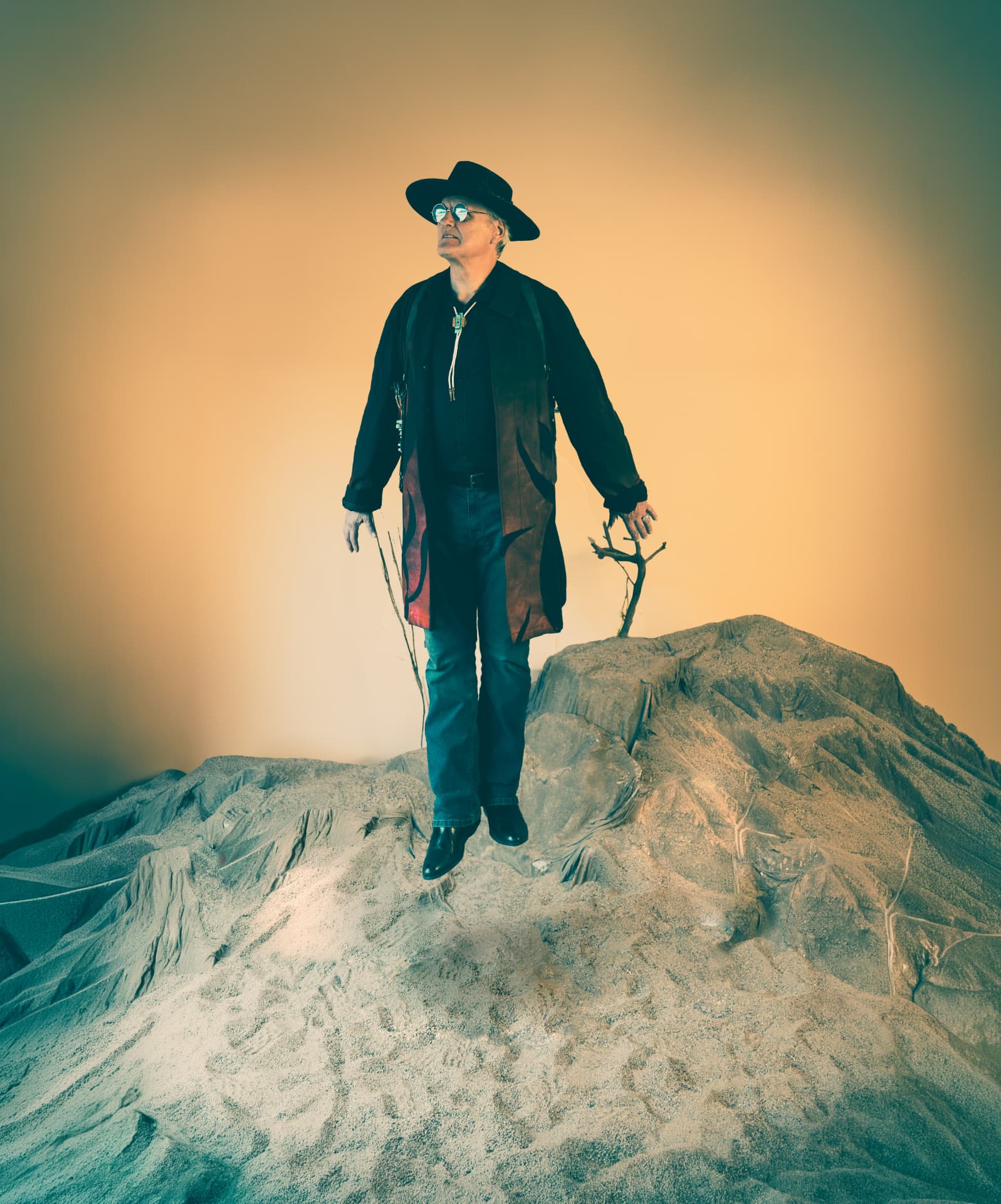
Chuck Wooke as The Traveler, in black hat and long coat, suspended above a sculpted desert mound against a glowing amber sky

Chapter I

The Desert

Sonoran Desert, Arizona

The journey begins beneath the open sky of the Southwest.

The Desert is the first fully realized visual world of The Traveler — shaped by dust, distance, weathered architecture, worn objects, analog machinery, open roads, and the strange beauty of the Sonoran landscape.

Here, the visual language developed through practical sets, found equipment, altered wardrobe, mechanical artifacts, studio experimentation, and location work.

The Desert does not define The Traveler.

It is simply the first place we meet him.

  • Photography
  • Video
  • Music
  • Written Story
  • Behind the Scenes

Chapter II

St. Ives

Visual chapter in progress

The next Chapter begins with the song.

“St. Ives” moves The Traveler toward a different atmosphere, a different landscape, and a visual world that has not yet been created.

Unlike The Desert, this Chapter currently exists first through the music.

Its imagery, objects, environment, and visual language are still waiting to be discovered.

For now, the music comes first.

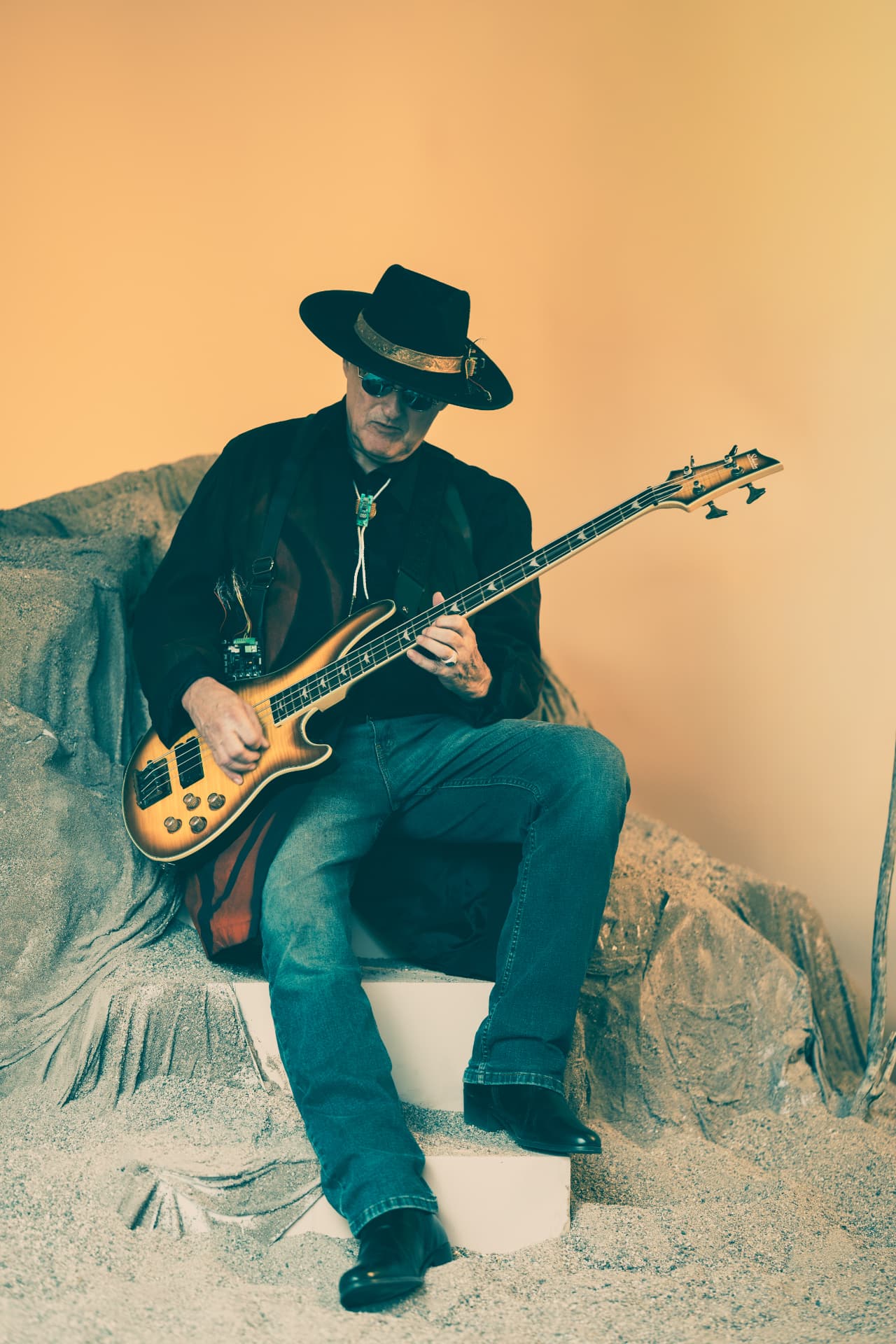
Chuck Wooke in black hat and sunglasses seated on sculpted desert rocks, playing a sunburst bass

The Journey Continues

The Traveler was never designed to arrive at a final destination.

As Chuck Wooke continues writing, recording, remembering, and telling stories, the world can continue changing with him.

New music may lead somewhere familiar or somewhere completely unexpected.

A new landscape.

A new object.

A new memory.

A new Chapter.

There is always somewhere else to go.

Stream now

Listen to Chuck Wooke